
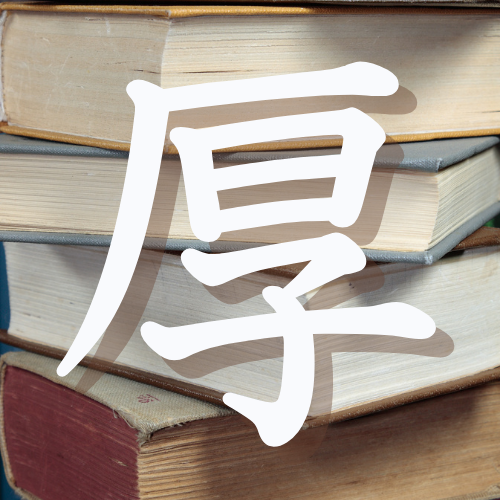

thick
worldview of『厚』
A single layer of batting is very thin.
In the girl’s hands, it may even look too delicate to be useful.
“Can this really keep someone warm?”
It is a reasonable question.
But Grandmother does not stop after one layer.
One.
Then another.
Then another.
She carefully places thin layers together.
And gradually,
thickness appears.
The important thing is that none of the individual layers has become thicker.
Each thin layer remains thin.
Yet when they come together, the whole gains something that no single layer possessed.
Human kindness can be a little like this.
Someone looks cold, so we ask,
“Are you warm enough?”
Someone is carrying something heavy, so we help for a moment.
Someone seems troubled, so we listen.
Someone tells us something important,
and later we remember it.
Each act by itself may seem small.
It may not be the kind of event that changes a life in an instant.
But when small acts of care are repeated,
there may come a day when we realize,
“This person truly cares about me.”
Perhaps this is a kind of thickness that grows between people.
Japanese uses 厚 in words such as 厚意, meaning kindness or goodwill.
That is interesting.
Kindness has no measurable thickness.
There are no centimeters or millimeters of compassion.
And yet we somehow understand what it means for care to feel substantial rather than slight.
Perhaps this depth does not come only from one dramatic act.
A small kindness.
Words exchanged many times.
A hand offered when we needed one.
Time spent together.
As these things accumulate, they create a depth that can be felt even though it cannot be measured.
But while making the futon, the girl learns something else.
Wanting to make it thick quickly, she tries putting a large amount of batting in one place.
Grandmother asks,
“Would it be comfortable if only that part were thick?”
Thickness is not simply about adding as much as possible.
It must be placed where it is needed,
in the amount that is needed,
with attention to the whole.
Care for another person may work the same way.
Something we consider helpful can become burdensome if we give too much of what the other person does not want.
So the beauty of attentive care is not simply its quantity.
It is care that reaches the places where it is actually needed.
A futon is not better merely because it is thicker.
It should be thick enough to keep the person beneath it comfortably warm.
Kindness, too, can surround someone without overwhelming them.
The futon the girl and Grandmother are making contains many layers of thin batting.
Each layer is light enough to seem almost insignificant.
But together,
they can surround an entire sleeping body with warmth.
Perhaps the kindness we have received throughout our lives is similar.
Not only the great acts we still remember,
but also countless small kindnesses we may already have forgotten
can remain layered within us,
quietly keeping us warm.
厚 is therefore not merely about having a great physical thickness.
It can suggest small things carefully accumulated until something substantial and sufficient has been created.
When someone eventually sleeps beneath the finished futon, they will not see each individual layer.
Yet every hidden layer will be helping to keep them warm.
Perhaps many of the things that warm a human heart
have been built in exactly the same way.
thick
story of『厚』
One late-autumn afternoon, the garden trees glowed red and gold, and soft sunlight reached across the tatami through the open shoji.
Grandmother spread a large piece of fabric across the room.
The girl helped from the other side.
“Grandma, what are we making?”
“A futon for winter.”
The girl looked at the fabric.
Even if she lay down on it, there would still be plenty of room beyond her feet.
“It’s huge.”
“It needs to be large enough to keep a whole person warm.”
A basket beside them was filled with soft white batting.
Grandmother carefully spread a thin layer.
The girl touched it with her fingertips.
“So fluffy.”
“Gently. We don’t want to tear it.”
Together, they spread the batting across the large futon.
From one end to the other,
trying to keep the thickness even.
When one layer was finished, Grandmother placed another over it.
The girl looked puzzled.
“Can something this thin really keep you warm?”
“One layer is still quite thin.”
Another layer.
Then another.
The girl copied Grandmother, carefully spreading the soft batting.
After a while, the futon began to look much fuller.
The girl gently pressed one edge.
Softly, it sank beneath her hand.
When she let go, it slowly rose again.
“It’s getting thick!”
“It certainly is.”
The girl looked at the layers from the side.
“But every piece is still thin.”
“That’s true.”
“They’re thin, but when lots of them come together, they become thick.”
Grandmother nodded.
They continued working.
They corrected places where the batting had shifted
and added a little more where it seemed too thin.
Wanting to finish quickly, the girl picked up a large lump of batting.
“If I put all of this here, it’ll get thick really fast!”
Grandmother laughed.
“But would it be comfortable if only one part were thick?”
“Oh…”
The girl carefully spread the lump out again.
“So the whole thing should be about the same?”
“That’s right.”
She gently worked the batting all the way toward the edges.
Eventually, the entire futon had become soft and full.
The girl looked at it proudly.
“This will be warm.”
Grandmother gently smoothed the surface.
“I hope someone sleeps warmly beneath it.”
The girl did the same.
Each layer of batting had once been so thin that it seemed almost weightless.
But one layer,
then another,
carefully placed together,
had created enough thickness to surround a sleeping person with warmth.
Perhaps warmth is not always something we create all at once.
Sometimes it appears quietly
when many small things are placed together,
gently,
again and again.
Kanji Card
Depth is born from accumulated time.
厚
You haven’t started yet